
The Deep Truths of Good Friday
Do you want to know how you can identify a timeless story? You know a story is timeless when people from all over the world pause to remember it every single year. Do you want to know how to discover if the timeless story is true? Well, if you want to hear the answer to that question, you will need to listen for a few minutes.
13th of Nisan: All the Buzz
Our story begins leading up to the 13th of Nisan in Jerusalem. The city was abuzz for a couple of reasons. First, the day of Passover was approaching. The Passover is the Jewish Holiday when it is remembered how God “passed over” the homes of the Israelites in preparation for being led out of slavery from the Egyptians. Exodus records the Passover as the 10th plague that God administered to the Egyptians. The Jewish Scriptures say the 10th plague is when the firstborn child was killed as an act of judgment from God. Celebrating the Passover is a way for Israel to remember the faithfulness of God. The Passover is filled with rituals and symbolism that are reflected in the Book of Exodus. And I would encourage you to pay attention to the rituals and symbols. Lambs or goats were slaughtered at the Temple on the afternoon of the 13th of Nisan. Each family or group provided a lamb (Exodus 12:3–4) and inspected it for blemishes. Then, the priests performed the sacrifice, and Levites sang Hallel (Psalms 113–118). The blood from the lamb was poured out at the Temple altar; the lamb was roasted whole and eaten the next day. There are additional rituals that include baking and eating unleavened bread for seven days. The unleavened bread represents the haste and speed needed for Israel to leave Egypt. Bitter herbs were eaten to remember the bitterness of slavery. Four cups of wine were set on a low-standing table to signify the promise of God’s redemption. The Passover was jealously guarded by the Jewish leaders. Only ritually pure and circumcised Jews could partake (Exodus 12:48). All these symbols pointed to a deeper truth. The Passover was a seminal point in history because God promised Father Abram that his descendants would be as many as the sands of the seashore, and they would be given “The Promised Land.” If there was one certainty for the enslaved Jews, they were not in the Promised Land.
Now, hundreds of years later, the Jews were in the “Promised Land,” and they jealously guarded their traditions and rituals of remembrance. They will not forget how they got to the Promised Land. Yes, there are historic and present political issues in the land of God’s people, but God has always been faithful to his covenant people.
The second reason Jerusalem was buzzing is because of the entrance of a Jewish teacher named Jesus, or as they said in 1st-century Aramaic, Yeshua. A handful of days prior to the 13th of Nisan, Jesus came into Jerusalem in a peculiar way. Many people called him a “king,” but what kind of king enters the Holy City on a donkey? Nonetheless, crowds gathered as Jesus traveled from Bethany to Jerusalem. The leaves from palm trees were plucked and placed on the ground as a sign of support and respect. For those who understood the deeper things of the Jewish faith, the palms were a declaration of triumph, victory, peace, and eternal life. Jesus had gained a reputation, for better and for worse, throughout Israel and even beyond the borders of Israel. He taught with authority, even though he was not formally trained in the Jewish Scriptures. There were rumors that Jesus raised the dead, healed the lame, and gave sight to the blind. For about three years, he has been ministering all around Israel and, in particular, the area of Galilee. Now, there had been a history of false prophets and messiahs throughout the region. It would be understandable if Jesus were summarily dismissed by many of the Jewish people. However, Jesus stands out as someone who is different from his predecessors. Yes, he performed many signs and miracles. Yes, he taught with authority. But Jesus was deeply compassionate with the poor and the children. He is also the same person who had the audacity to clear the temple of money changes. That was quite the scene. Here is what happened. Jesus made a whip out of cords and overturned tables. The religious leaders were not happy with Jesus, but here is the dirty little secret that no one wanted to confront. For all the bloviating about following “The Law,” what was going on in the temple was wrong. Everyone knew it. But as long as the right people were filling their pockets with denarii, there was a fear of crossing the wrong people. After Jesus cleared the temple, he was said to quote the prophet Isaiah, “My house will be called a house of prayer for all nations (Isaiah 56:7).” Jesus quoted Isaiah as if the first person singular was personal. “My house,” Jesus said. He also quoted the prophet Jeremiah, “But you have made it a den of robbers. (Jeremiah 7:17).” And there was the accusation. Those who were selling and trading were robbers. Jesus rebuked the corruption of the temple’s commercialized environment, comparing it to a hideout for thieves exploiting others. No one had the courage to confront the religious corruption before Jesus.
So, between the Passover holiday and Jesus’s arrival in the Holy City, the rumor mill was working in high gear.
14th of Nisan: The Passover Meal
Then came the day of Unleavened Bread (Nisan 14), on which the Passover lamb had to be sacrificed. In preparation, Jesus summoned Peter and John. Peter and John were two of Jesus’ closest disciples. He entrusted them to procure what was needed for the Seder meal. Jesus said to them, “Go and prepare the Passover for us, that we may eat it.” The instructions were straightforward – unleavened bread and wine were on the menu – however, they did not have a place to have the meal. Peter and John had the same question on their minds. “Where will you have us prepare it?” The response from Jesus is similar to how he received a donkey before riding into Jerusalem. Jesus said, “Behold, when you have entered the city, a man carrying a jar of water will meet you.” Jesus continued. “Follow him into the house that he enters and tell the master of the house, ‘The Teacher says to you, Where is the guest room, where I may eat the Passover with my disciples?’ And he will show you a large upper room furnished; prepare it there.” Peter and John responded with similar expressions, but neither were no longer surprised by the instructions. Even when they do not understand, everything goes according to plan. They went and found the upper room just as Jesus had told them, and they prepared the Passover. Later that evening, the 12 disciples and Jesus gathered in the upper room. Peter and John, along with several women, prepared the meal. The thirteen reclined at the low table, and Jesus began speaking. Jesus expressed his deep desire to eat the Passover with them. But what was different about this Passover? The twelve had been walking with Jesus for several years, and this was not the first holiday that they had celebrated together. But a seriousness set in after he said these words. “I have earnestly desired to eat this Passover with you before I suffer.” Suffer? What was he talking about? The bitter herbs spread around the table were meant to express the suffering their forebears escaped from. But now Jesus says he is going to suffer? Thomas made the connection. He looked at the herbs and then looked up to Jesus. His teacher continued, “For I tell you the truth, I will not eat until it is fulfilled in the kingdom of God.” Several of the disciples looked flummoxed. Will Jesus fast after the Seder meal until the promises of the kingdom of God are fulfilled? What does that mean? The typical look of confusion set in on all the disciples.
The words of Jesus hung in the air, and then he seamlessly got up, grabbed a water basin, filled it with water, and tied a towel around his waist. One by one, Jesus began to wash the feet of his disciples. Most of them willingly received this ministry of Jesus, except for Peter. Peter insisted that he wash the feet of Jesus, but Jesus refused, and then he proceeded to teach Peter another lesson. This time, the lesson was simple and to the point. Jesus has served them, and now Jesus is asking them to serve others. As the evening progressed, two notable and foreboding moments took place. As they ate, Jesus said, “Truly, I say to you, one of you will betray me.” The statement caused a stir. Everyone began to be suspicious of themselves, everyone except for one person. Simon Peter asked Jesus quietly, “Lord, who is it?” Jesus answered in a way that commanded the entire room. “It is he to whom I will give this morsel of bread when I have dipped it.” When he had dipped the morsel, he gave it to Judas, the son of Simon Iscariot. After Judas had taken the bread dipped with wine, an extraordinary scene occurred. Judas had a visceral reaction as if Satan had entered his body. His body momentarily had tremors. After the episode, Judas immediately got up and left the room. He walked downstairs and out the front door into the night. The next actions taken by Judas would result in treachery and land him in Dante’s 9th and lowest circle of hell.
Jesus rose to calm the remaining eleven disciples. His presence was enough to calm nerves. What Jesus was about to do connected the past, present, and future. It was time for the Seder meal. Jesus took the bread, blessed it. Broke it, and then he distributed it to the eleven. He simply instructed, “Take, eat.” And then he said, “This is my body.” The disciples were processing in real-time. What does he mean by saying the bread is “my body?” Again, deeper truths were at work. Before they could collect their thoughts, Jesus grabbed one of the chalices filled with wine. Jesus looked up into heaven, raised the humble wooden chalice with two hands, and gave thanks. He said, “Drink of it, all of you, for this is my blood of the covenant, which is poured out for many for the forgiveness of sins.” John looked at Jesus with keen attention. Four words bounced around in his brain. Blood. Covenant. Forgiveness. Sins. His mind went to all the temple sacrifices. The words of Jesus were indeed foreboding and ominous for most of the disciples. The moment was profound, and another surname for Jesus flooded the brain of the eleven. Christ. What is the chosen one of God going to do? The eleven did not know what Jesus Christ would do next, but they all believed he was anointed by God most high. As Jesus lowered the cup filled with wine, he reiterated a point from earlier, but it could have been easily forgotten due to the scene with Judas. He said, “I tell you I will not drink again of this fruit of the vine until that day when I drink it new with you in my Father’s kingdom.”Jesus took a sip and then passed the cup around the table.
The eleven and Jesus took time to fellowship, but the evening was growing long. However, Jesus’s burden was significant. Everyone thought the evening was ending, but Jesus rose and invited his disciples to follow him.
15th of Nisan
It was late, sometime after 11:30pm. It would soon be the 15th of Nisan. Jesus led his disciples to the Garden of Gethsemane. James, John, and Peter followed Jesus into the garden while the others were instructed to stay behind. The garden had been a favorite place for Jesus to pray. All his disciples knew this, including Judas. Jesus instructed the three to stay awake and pray while he went off to pray on his own. An hour passed, and Jesus returned to James, John, and Peter to find them asleep. He woke them up, telling them they must stay strong in the Spirit. However, the pattern was repeated two more times. Finally, the hour had come. Judas arrived to finish what he started. He walked past the disciples at the garden entrance, but he was not alone. The Chief Priest and Pharisees sent a crowd of thugs with swords and clubs to detain Jesus. They walked on the garden path, and as Judas turned a corner, he saw Jesus with the three. Jesus acknowledged Judas and said, “Friend, do what you have come to do.” Just as Jesus finished the sentence, Judas kissed Jesus’s cheek. Jesus said to Judas, “You betray me with a kiss?” All of a sudden, the band of thugs moved on Jesus. Peter drew a sword and cut off the ear of the High Priest’s servant. However, Jesus diffuses the tension and tells Peter to stand down. Jesus knew what needed to be done, and it did not include violence from him or his disciples. As Jesus was taken away, all the disciples fled out of fear for their lives.
Dawn approached, and Jesus was taken to the High Priest. He would face a series of trials in front of the religious leaders. If there were one accusation they wanted to nail Jesus with, it would be blasphemy. Annas was an ex-high priest, and Caiaphas was the current high priest. It was still dark, and the questioning began. Annas, the father-in-law of Caiaphas, questioned Jesus first. But it was not long before Annas realized he was not going to get much out of Jesus. Jesus is then taken to the Sanhedrin and Caiaphas. Before the Sanhedrin, Jesus is blitzed with questions. For the longest time, Jesus remained silent, which only frustrated the council.
Then, the real reason for Jesus’ capture was made evident. Someone asked, “Are you the Christ, the Son of the Blessed?” As odd as it might seem, this was the question that Jesus was waiting for. Jesus wanted to make it clear that he was more than the Christ. Jesus said, “I am, and you will see the Son of Man seated at the right hand of Power, and coming with the clouds of heaven.” During his ministry, Jesus taught the crowds using two precious words, “I am.” Most of the people in the crowds did not know what was being implied. However, a learned Pharisee knew exactly what Jesus meant. He understood the deeper meaning. Jesus just told the Sanhedrin that he is God. The religious leaders tore their robes and arrived at their premeditated conviction. Jesus was being charged with blasphemy. Looking at Jesus, the High Priest exclaimed, “What further witnesses do we need? You have heard his blasphemy.” He then pivoted to look right at the members of the Sanhedrin and said, “What is your decision?” And in an instant, they all condemned Jesus to death. Now, they just needed the Romans to do their dirty work. Some of the Pharisees began to spit on Jesus. They also covered his face with a cloth and struck him. With a mocking voice, some said, “Prophesy!”
Jesus before Pilate
The sun was finally rising, and Jesus was led to the Roman governor, Pontius Pilate. After an initial questioning before the Roman governor, Pilate sent Jesus to Herod. Pilate did not want to play Jewish politics. Herod eventually sent Jesus back to Pilate, which is when Pilate realized Jesus was his problem. Pilate did not understand why the religious leaders wanted Jesus to be punished. But they persisted. Pilate looked for a way out and presented an option. It was a Jewish tradition for a prisoner to be released during this holiday season. Therefore, Pilate presents a murderer named Barabbas before the ever-growing crowd. Surely, the crowd would not want a murderer released back into their community. The crowd had grown considerably as Roman soldiers went off to fetch Barabbas. When Barabbas arrived, he placed him to his right and Jesus to his left. He then asked, “Do you want me to release for you the King of the Jews?” Pilate asked the question that way because he knew the religious leaders were envious of Jesus and his following. But the chief priests stirred up the crowd as if the crowd only had one mind. Chants of “release Barabbas” began to get louder and louder. The crowd was so loud that Pilate had to gesture to the crowd to lower its voice so he could speak again. “Then what shall I do with the man you call the King of the Jews?” And they cried out in unison, “Crucify him.” Pilate said to the crowd, “Why? What evil has he done?” But they shouted all the more, “Crucify him.” Pilate released Barabbas into the crowd, and Jesus was delivered over to the Roman soldiers to be scourged and crucified. Now that the die had been cast, Jesus was to be made a spectacle. An entire Roman battalion was called together to watch as a purple cloak was put around the shoulders of Jesus. Another soldier created a crown made out of thorns. It was twisted together, and it was placed on his head, and it was pressed into his skull. Blood now began to run down the face of Jesus. The mocking continued as the Romans saluted Jesus and said, “Hail, King of the Jews.” They struck and spat on Jesus repeatedly. Jesus was brutally flogged. A few Romans got on their knees to mock the alleged king. He was eventually stripped of the purple cloak while the crown remained on his head. Again, another deep truth that no one realized in the moment. When the spectacle was over, Jesus was led away to be crucified. It was now around 8:00am on the 15th of Nisan when Jesus arrived at the foot of the hill called Golgotha. He was bloodied and weak. He was humiliated as he carried a wooden cross to the foot of the hill, which led to his death.
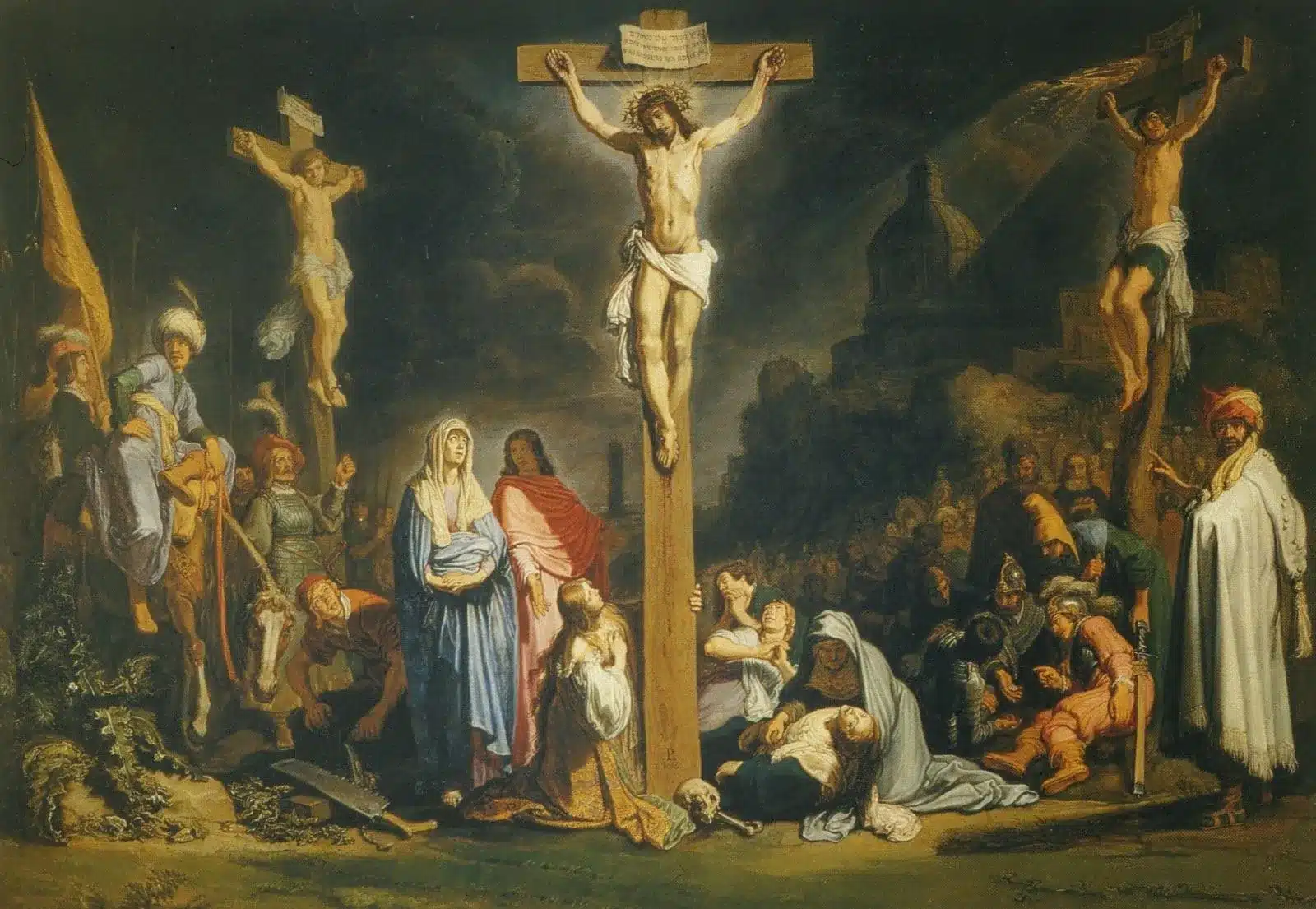
A Roman soldier noticed that Jesus was extremely weak. The beating he had endured was worse than previous crucifixions. At random, a man named Simon of Cyrene was thrust forward to help Jesus carry the cross. And up the hill, they went. Not long ago, a crowd laid palm branches down to celebrate Jesus. Now, an entirely different crowd was hurling insults and spitting at him. When Jesus arrived at the place to be crucified, Simon was relieved of his duty and faded back into the crowd. Two thieves had already made their way to the top of the hill to be crucified. Preparations were made, and the mocking continued. And then the time came, and the cross was ready. Laying down on the cross, Jesus took on the shape of the cross. Out came the hammer and nails. A Roman executioner grabbed his hammer, placed a nail in the left wrist of Jesus, and swung down. Thump. Thump. Thump. The sound seemed to reverberate even though they were outside. Jesus winced in agony, knowing what it all was for. The executioner moved to the right wrist. Thump. Thump. Thump. And then, finally, one nail went through the right and left foot of Jesus. Around 9am, all three crosses were erected with Jesus in the middle.
Jesus was crucified for approximately 6 hours. For 6 hours, the mocking continued, but so did a miracle. One of the thieves looked to Jesus and said, “Are you not the Christ? Save yourself and us!” But the other criminal rebuked the mocker. The second criminal attempted to look at the eyes of Jesus, yet with reverence, and said with faith, “Jesus, remember me when you come into your kingdom.” With compassion and mercy, Jesus responded, “Today, you will be with me in paradise.” With that, the 3 O’Clock hour arrived, and darkness began to cover the land. Jesus expressed his anguish, “Eli, Eli, lema sabachthani?” that is, “My God, my God, why have you forsaken me?” And then Jesus said, “It is finished.” In that moment, Jesus, the Christ, breathed his last. Then, there was an earthquake. Between the darkness, the earthquake, and other events that unfolded, some people began to wonder, “Was the most high God watching down?” Moved with pity but also with awareness, one of the Roman soldiers summed it up well. He said, “Truly, this was the Son of God.”
In an odd way, this part of the story ends where it began about 33 years ago. Jesus was born to an earthly mother, Mary, and was also raised by Joseph, a carpenter by trade. Now that Jesus had died, another Joseph of Arimathea was given permission by Pilate to take down the body of Jesus and place it in an empty tomb. Accompanying Joseph was Mary Magdalene, who helped prepare the body of Jesus before the sun fell off from the sky.
As the 15th of Nisan gave way to the next day, another deep truth about the work of God would soon be revealed.